PGP
Day 67 / 100
I haven't talked about PGP.
My impression is that because I haven't worked with it much, I don't know it well. But like Infotécnica, I think it's a surprisingly good product.
And for my case it's even better. PGP is where the studies and the up-to-date DIgSILENT databases live. In other words, everything Don Nelson needs to learn from.
This is the first of several posts where I'll talk about PGP.
What PGP is
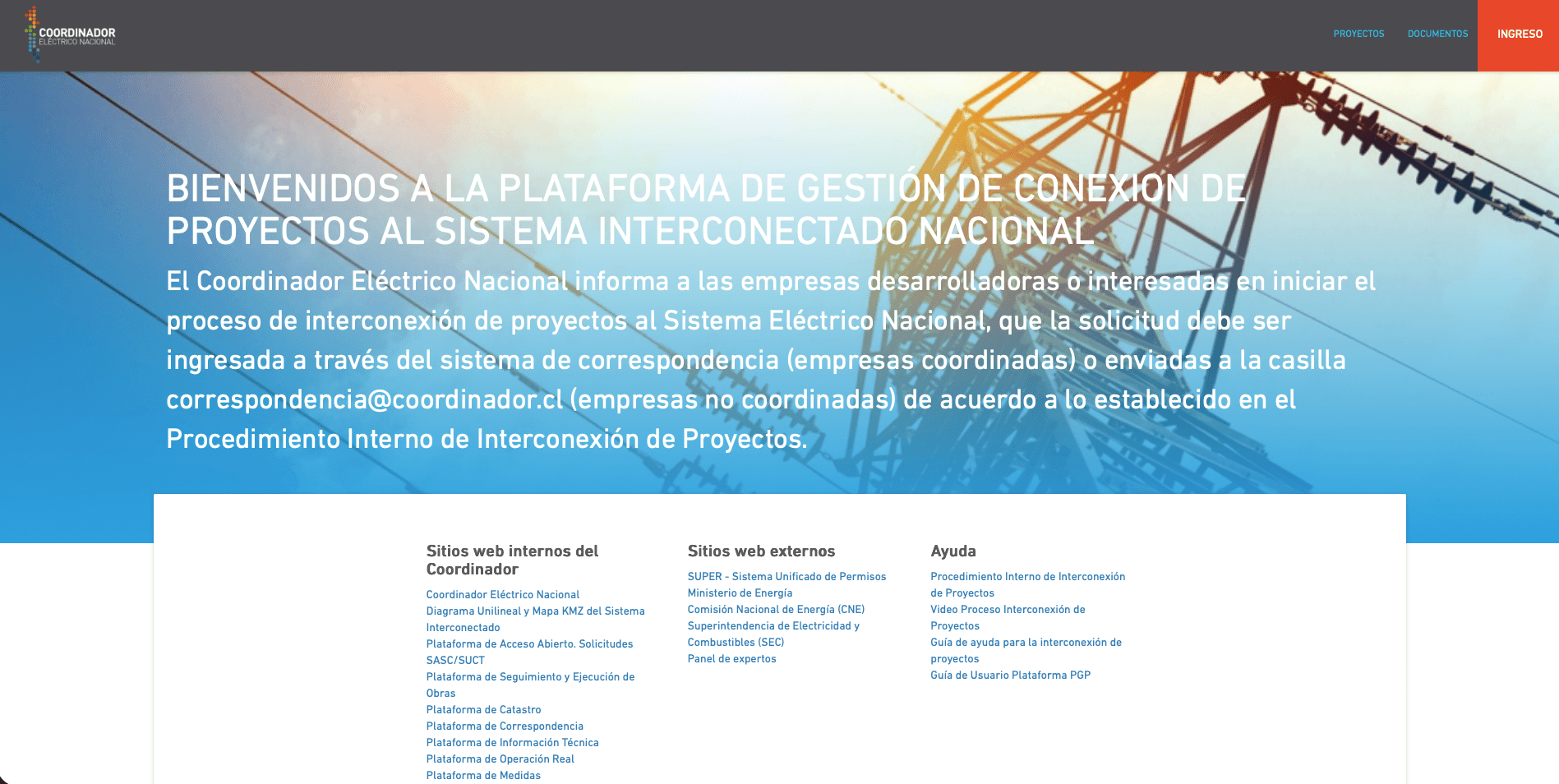
PGP is the CEN's Project Management Platform. They launched it in March 2018.
These are the projects that will soon enter and interconnect with the SEN.
Right now there are 2,514 projects in there. Solar farms, BESS, lines, substations, minor modifications.
Project types
Three types of projects go through PGP:
- NI — New Installations. A new substation, a new line, a new plant. Something that didn't exist before.
- MR — Relevant Modifications. When a company changes equipment in a way that affects the topology or the short-circuit levels at the connection point.
- MNR — Non-Relevant Modifications. Equipment replacements, minor tweaks, changes that don't alter the topology.
Each type has its own associated studies. An NI requires the full set. An MNR comes out with much less.
PGP snapshot
2,514 is just a number.
I pulled the entire PGP. All 2,514 projects. Every technical study. Every date. Every iteration with the CEN.
Then I sliced it by dimension. Here's what I saw.
A lot of what's in PGP is substation modifications.
1,785 substation expansions. 123 brand-new substations. The "substation" category alone is 76% of the pipeline.
Generation —solar, wind, hydro, thermal, BESS— doesn't reach 11%.
And 84% of PGP are expansions. Not new installations.
The system is being upgraded.
The pipeline is growing.
2025 was a record: 322 projects.
2026 already has 149 in five months. At that pace it ends above 350.
How long each study takes to be approved
That was the what and the who. Now the bottleneck: how long each study takes.
I pulled the public PGP data and measured three things per study:
- How many projects need it.
- What share is approved on the first try.
- How many days pass between the first draft and approval.
I excluded administrative and post-operation phases (EME, GM, SEC letter, SCADA, SITR). Those aren't study work — they're natural waits until entry into operation.
This is what came out:
| Study | Needed | Approved | % 1st try | Avg iter. | Days (median) | Days (avg) |
|---|---|---|---|---|---|---|
| EFP — Power Flow Study | 360 | 261 | 20% | 2.33 | 73 | 124 |
| ECAP — Protection Coordination & Setting Study | 1,509 | 1,099 | 28% | 2.76 | 123 | 218 |
| ET — Transient Stability Study | 328 | 239 | 31% | 1.95 | 56 | 100 |
| EMT — Grounding Mesh Verification Study | 707 | 540 | 38% | 1.84 | 70 | 107 |
| ECC — Short Circuit Study | 778 | 599 | 51% | 1.67 | 47 | 85 |
| ECB — Bus Capacity Study | 637 | 477 | 61% | 1.51 | 40 | 74 |
| ECA — Insulation Coordination Study | 646 | 502 | 71% | 1.32 | 21 | 60 |
What stood out
The EFP is the hardest to approve on the first try. Just 20%.
Less than ECC (51%), ECB (61%) and ECA (71%). And it makes sense. EFP brings in subjective CEN criteria: scenarios, contingencies, operational margins. The consultant and the reviewer almost always end up arguing.
ECAP is the most universal. 1,509 projects need it.
Double the next one. And it's not trivial: 28% on the first try, 2.76 average iterations, 123 median days.
Multiply that by 1,099 approved studies and you get hundreds of thousands of consultant-days concentrated on a single function.
The gap between mathematical and interpretive studies is brutal.
ECA and ECC have clear rules. 71% and 51% on the first try. Less than 50 median days.
EFP and ECAP are interpretive. Subjective criteria, more rounds, more days.
The difference isn't technical complexity. It's how standardized the approval criteria are.
Median vs average tells a different story.
For ECAP, the median is 123 days but the average is 218.
Half the projects get approved in 4 months. But the slow tail drags the average to almost double. The ones that go well are fast. The ones that get stuck take a year.
What I saw here
The first read is obvious: drop AI where the volume is. ECAP, EFP.
But ECAP is precisely the hardest study to automate. Not out of CEN stubbornness. By the nature of the problem. Coordinating protections isn't a calculation, it's a negotiation between criteria. That's why it gets bounced 3 times.
The market pays for what is hard to automate.
ECC is cheap because anyone with DIgSILENT can solve it. ECAP is expensive because they can't.
But for Don Nelson there aren't two roads. There's only one.
I have EFP and ECC well underway. Those are going to ship. ECAP is what will take me the most time — and it's precisely what no one has solved.
That's why I have to solve it.
I'm going to solve it.
What's next
I'll write more posts about PGP. Things on my mind:
- Full analysis of the connection process.
- Which companies have the best first-try approval rate. And what they do differently.
- The real bottleneck: is it the CEN reviewing or the companies responding?
I'm also thinking about exposing an API and a PGP skill, similar to what I did with Infotécnica.