EDITH

As I mentioned in an earlier post, back when I benchmarked the best machine to run Don Nelson, I left something pending: I wanted to build a computer to run DigSILENT faster and cheaper than the cloud. I finally did it.
And it isn’t one computer — it’s really the first of a set of computers + agents meant to run electrical simulations. I gave that set a name: EDITH.
Why EDITH?
The name comes from two places.
The first, and the one that matters most to me, is Edith Clarke. At my university (USM) “Miss Clarke” came up a lot, and only now, building this project, did I sit down to really read about who she was.
Edith Clarke (1883–1959) was the first woman to earn a master’s in electrical engineering from MIT (1919) and the first woman professionally employed as an electrical engineer in the United States (1922, at General Electric). In an era when the role literally didn’t exist for a woman, she ended up leading power system stability engineering and, in 1947, became the first female professor of electrical engineering in the country, at UT Austin.
But what I love most about her story is the Clarke calculator (patented in 1925): a graphical device to solve current, voltage and impedance equations on transmission lines ten times faster than the methods of the time. In other words, 100 years ago Edith Clarke was already obsessed with the same thing I am: running power system studies faster. The U.S. Department of Energy calls her the “founding mother” of the smart grid.
There’s a line of hers, from 1948, that stuck with me:
“There is no demand for women engineers, as such… but there’s always a demand for anyone who can do a good piece of work.”
It felt only fair that the computer I built to speed up electrical studies carry her name. You can read more about her here.
The second place is geekier: EDITH is also Tony Stark’s last AI in the Marvel universe, the one he leaves to Peter Parker when he dies. A system that sees everything, monitors everything and is always available. Which is, more or less, what I want EDITH to be for me.
Why my own computer and not the cloud?
I’d been running everything on Google Cloud. I was paying between 500 and 700 dollars a month, of which something like 60–70% was compute. And the worst part is that with that spend I didn’t even have the VMs running 24/7. I’d turn them on, work, turn them off — I’d say something like 10 to 20% of what I could have been using them.
EDITH changes both things. It runs 24/7 and it runs much faster, at a fixed cost that pays for itself in a few months compared to what I was burning in the cloud.
But I’ll be honest: I don’t think there’s a hard “why” between cloud and local. Both work. What finally convinced me is something deeper: I believe compute is the new oil, and I want in on that. Having my own iron, powered on, doing real work while I sleep, feels like being more on the right side of that idea.
EDITH today
For now EDITH is a single computer, all CPU, built mainly to run DIgSILENT PowerFactory:
- CPU: Intel i9 14900K
- RAM: 32 GB
- SSD: 1 TB
- Cooling: Arctic Liquid Freezer III
- OS: Windows 11 Pro
One important decision: EDITH is isolated. It’s not exposed to the internet. Only my computer can reach it, through Tailscale, so it lives on my private network as if it were right next to me even when it’s in another room or I’m somewhere else.
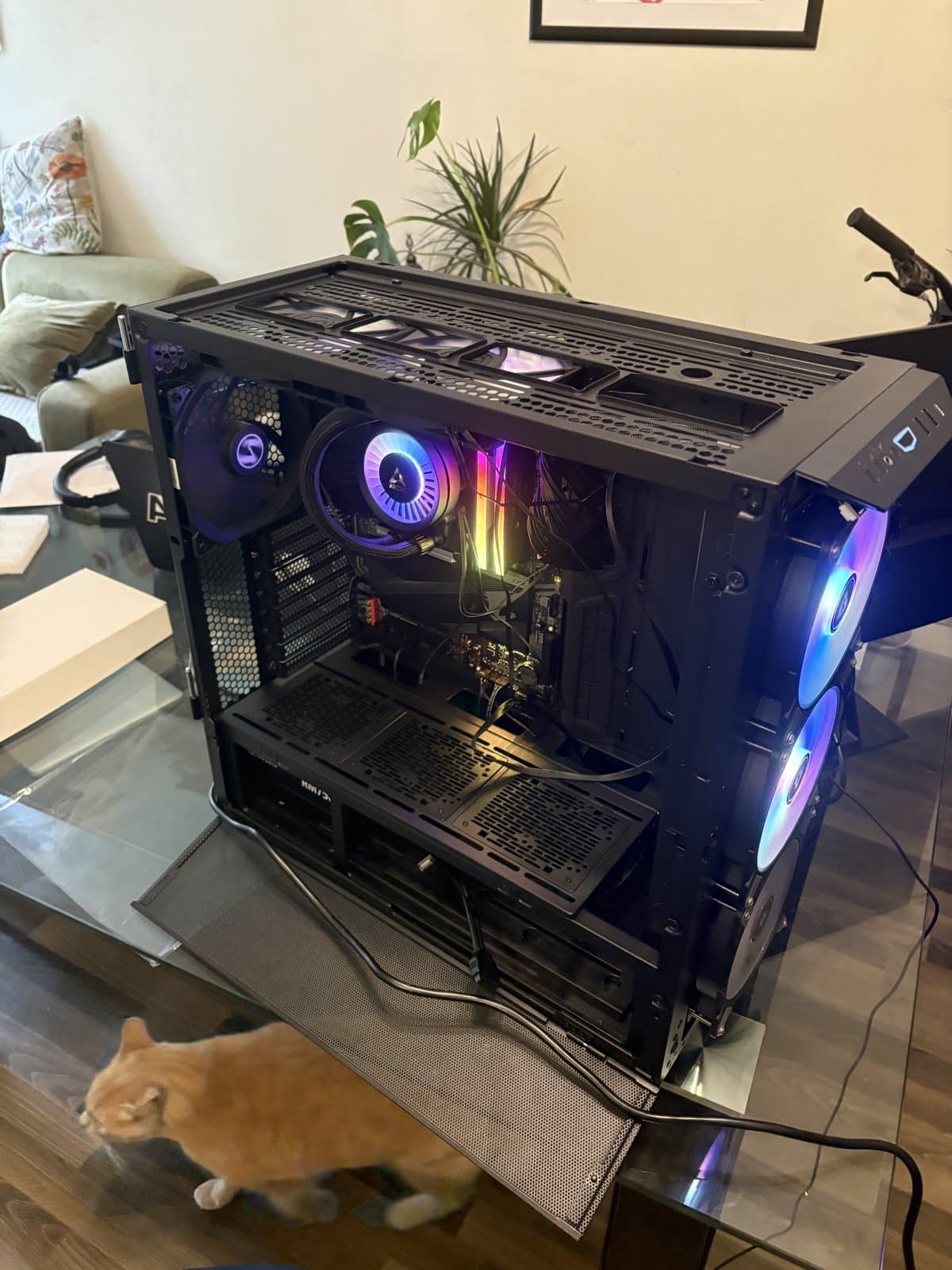
EDITH assembled and running.
The agent: EDITH monitors itself
Here’s the part I had the most fun with, and still do. EDITH is not just the hardware — it’s the hardware plus an agent that looks after it. That’s what makes it feel alive and not just a PC powered on in a corner.
Since I have an electronics background, I built my own board to take measurements. I used a couple of ESP32s left over from a previous company, an SHT20 sensor for temperature and humidity, and a PZEM to measure the electrical side. With that, EDITH monitors itself:
- Environment: temperature and humidity of the room where it lives. I’ve spent weeks measuring to understand how the room temperature changes before and after having EDITH on.
- Consumption: voltage, current, power and power factor it draws, sampled every 1 second (I store the average every minute).
- Compute: the most important part — I measure the temperatures of every core of the i9 and each core’s frequency, and on top of that EDITH estimates what each core is being used for.
All of that lands in a dashboard where I can see the curves live, and if something goes out of range, EDITH texts my phone. It’s the same logic as my other agents: it’s not a chatbot that answers questions, it’s something that does things for me while I do other things.
In fact, I made part of that monitoring public and live: you can see EDITH’s temperature, humidity and power consumption (voltage, current and power) in real time on the mini-datacenter view.
Benchmark: EDITH vs the cloud
I ran on EDITH the exact same case I used for the cloud machine benchmark (you can see it here): 25 consecutive power flows over the same system (9,319 MW of generation, 8,892 MW of load, convergence in 7 iterations) — so the comparison would be clear and fair.
The result: EDITH averages 1.312s per flow. The best machine I’d tested on Google Cloud (the c4-highcpu-4) clocked 2.192s, and the cheapest (c2-standard-4) 3.903s.
So EDITH is ~40% faster than the best cloud VM and nearly 3x faster than the c2-standard-4. And that’s running locally, with no per-hour bill.
But the average doesn’t tell the whole story. The most interesting part is the stability under sustained load:
This validates the whole thesis of the project: to run DigSILENT the only thing that matters is core frequency. A local i9 at 6 GHz beats every VM I tested — running 24/7 and at a fraction of the cost.
Where EDITH is headed
The idea is for EDITH to grow over time. Today it’s one node, but the plan for this year is:
- A second CPU so I can run two simulations in parallel.
- A GPU node to do local inference and stop depending only on external APIs for the AI side.
My mini-datacenter at home, basically.
Acknowledgements
A special thanks to Eugenio Voticky, my legal advisor, without whom EDITH wouldn’t have been possible. And to Macarena, my lifelong partner, who lets me do this kind of craziness and lets EDITH live 24/7 in our home (for now).